ERHALTEN SIE SOZIAL MIT UNS
AKTUELLE ARTIKEL


Newsletter
Bleiben Sie über die neuesten Werbeaktionen, Neuigkeiten und Veröffentlichungen auf dem Laufenden!
Standard Piercing Gauge Sizes Explained
Here are the standard gauges by placement, so you can match new jewellery to your piercing at a glance:
- Nostril — 20g to 16g (0.8mm–1.2mm); studs are commonly 16g
- Septum — 16g (1.2mm)
- Lip / labret — 16g (1.2mm)
- Tongue — 14g (1.6mm)
- Nipple — 14g (1.6mm)
- Belly — 14g (1.6mm)
These are the sizes most people are pierced at and the gauges most of our jewellery is made in. Your own piercing may differ, so if you are unsure, measure what you currently wear before you buy.

What does gauge mean?
Gauge is the thickness of the bar or post that goes through the piercing — not the length, and not the decorative part. It uses an inverted scale, which catches a lot of people out: the higher the gauge number, the thinner the jewellery. So 20g is finer than 18g, and 14g is thicker than 16g. Because the numbers are not intuitive, the millimetre measurement is the reliable one to go by: 20g is 0.8mm, 18g is 1mm, 16g is 1.2mm and 14g is 1.6mm.
What gauge is a nostril piercing?
Nostrils are usually pierced at 20g (0.8mm) or 18g (1mm), the finest gauges on this list, and nostril jewellery runs across this range up to 16g (1.2mm) — our nose studs are commonly made at 16g. Because the range is narrow, the difference is small but real, so match the millimetre figure of the piece you wear: a finer stud will slip into a wider piercing but feel loose, and a thicker one will not fit without stretching.

What gauge is a septum piercing?
Septums are most often pierced at 16g (1.2mm). Septum jewellery is also made in thicker gauges for those who have stretched the piercing — 14g, 12g and up — but 16g is the standard starting size and the one most clickers, horseshoes and rings are made in. Diameters of 8mm and 10mm are the common fits.

What gauge is a lip or labret piercing?
Lip and labret piercings are standard at 16g (1.2mm), the same as the septum. Lengths of 6mm, 8mm and 10mm cover most placements, with the right length keeping the back disc comfortable against the gum.

What gauge is a tongue piercing?
Tongue piercings use a thicker 14g (1.6mm) bar, because the tongue is a strong muscle and needs a sturdier barbell. Lengths of 14mm and 16mm are standard to allow for the thickness of the tongue.

What gauge is a nipple piercing?
Nipple piercings are standard at 14g (1.6mm), the gauge our nipple bars are made in. Like the tongue, the nipple sits at a sturdier gauge than facial piercings.

What gauge is a belly piercing?
Belly (navel) piercings are standard at 14g (1.6mm). This is the thickness most banana bars and belly jewellery are made in, so a 14g piece is the safe default for a navel piercing.

Is piercing gauge the same as ear-stretching gauge?
No — and this is worth clearing up. Ear-stretching uses the same gauge scale but runs into the much thicker sizes: plugs and tunnels are measured in gauges like 2g, 0g and 00g and then in millimetres and fractions of an inch as they get bigger. Piercing jewellery in this guide stays in the fine 14g–20g range. If you are looking for plug and tunnel sizes, that is a separate scale.
How do I measure my gauge?
At these sizes a ruler is no help — the difference between 0.8mm, 1mm and 1.2mm is far too fine to read off one. The reliable way is to go by how the jewellery you already wear was sold: the product listing or the paperwork from your piercing almost always states the gauge. If you need to measure a piece in hand, use digital callipers on the thickness of the straight part of the post, or a gauge wheel (a sizing tool with graded slots) — both resolve tenths of a millimetre, which a ruler cannot. If you are still unsure, your piercer can tell you the gauge in seconds.

What material should the jewellery be?
Whatever the gauge, all our piercing jewellery is ASTM F136 titanium — implant-grade, hypoallergenic and a good choice for sensitive skin. Titanium is light, which matters most on the finer nostril gauges, and strong, which matters on the thicker tongue and nipple bars.
Once you know your gauge, shop by placement: nose, septum, lip, tongue, nipple and belly.
BESTSELLER


Schwarzer Silikon-Ohr-Tunnel
ab
£4.00


Schwarzer Double-Flared-Tunnel aus Edelstahl
ab
£7.00


Klar & Schwarz Single Flare Glas Plug / Gauge
ab
£5.00


Opalitglas Plug / Messgerät
ab
£7.00


Blaue & grüne irisierende Glas-Ohr-Tunnel
ab
£11.00


Marmor Schwarz & Roter Stein Plug / Messgerät
ab
£9.00


Amethyst Stein Tunnel
ab
£10.00


Schwarzes Metall-Dead-Stretching-Set
ab
£17.99
NEU
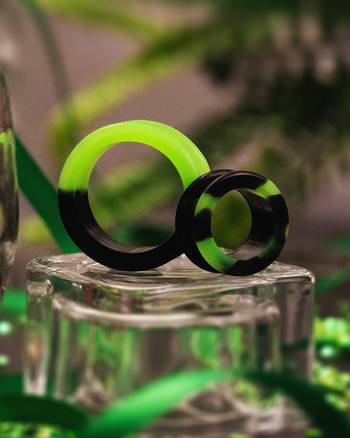

Neongrüner & Schwarzer Silikon-Ohrtunnel in Marmoroptik
ab
£7.00
NEU


Clear & Schwarzes Glas-Dead-Stretching-Set
ab
£16.99
NEU